 Download App
 Track Order
 Help Center

Sell vs Exchange iPhone: Which Gives Better Value?
You are holding your old iPhone in one hand and a new iPhone offer on the screen in the other. A question pops up in your mind — should I sell this iPhone or just exchange it?
Exchange Your Device
Lakhs of Indians ask this same thing every festive season, every time Apple launches a new model. And most of them make the decision in a hurry, without checking the actual numbers. That one rushed choice can cost you anywhere between ₹3,000 to ₹15,000 — real money that quietly slips out of your pocket.
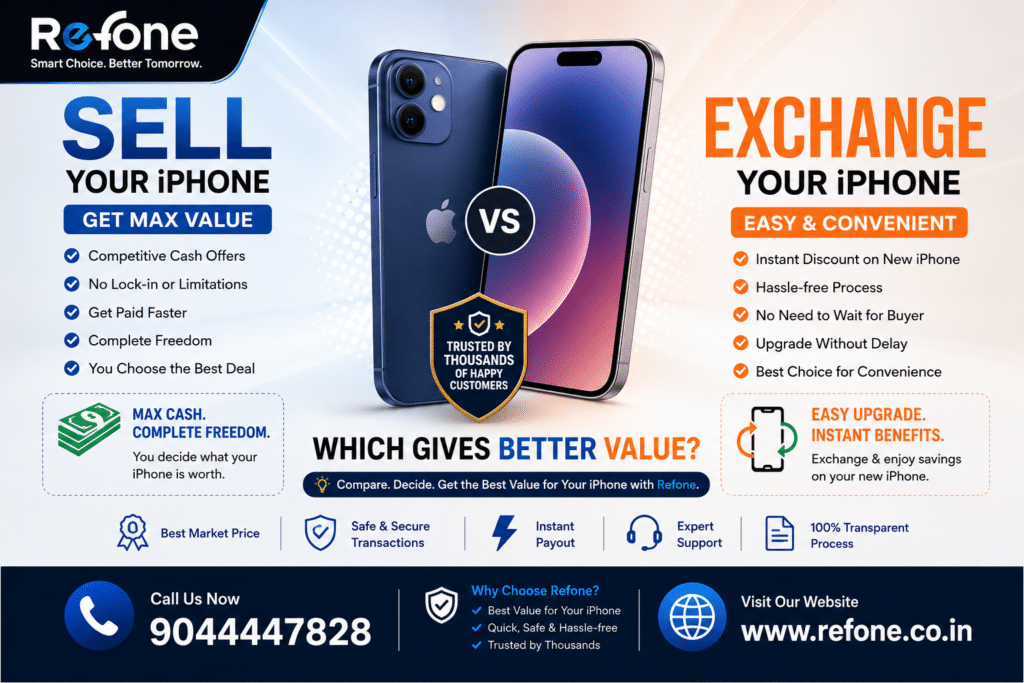
This guide breaks down sell vs exchange iPhone in plain, simple language. No jargon, no sales pitch — just the facts, the maths, and a clear answer for your specific situation. By the end, you will know exactly which route puts more money in your hand, and which one saves you the most time and hassle.
Also Read – How to Check Battery Health Before Buying a Refurbished iPhone (2026 Guide)
Sell or Exchange iPhone: Which Is Better?
Here’s the short answer before we go deep: if maximum cash is your priority, selling almost always wins. If convenience and speed matter more, exchange is the easier path.
But “almost always” is doing a lot of work in that sentence, so let’s unpack it properly.
When you sell an iPhone, you are dealing directly with a buyer — a person, a platform, or a trusted resale service like Refone. There is no bundled offer, no hidden adjustment. You get paid for exactly what your device is worth in today’s market.
When you exchange an iPhone, a retailer or Apple’s own trade-in program values your old device and knocks that amount off the price of a new one. It feels convenient because everything happens in a single transaction. But that “convenience fee” is usually baked into a lower valuation.
Neither option is wrong. They just serve different needs. The rest of this article helps you match the right option to your situation.
Buy Certified Refurbished iPhone
Super Quality iPhones at Smarter Prices
Sell vs Exchange iPhone: Quick Comparison Table
| Factor | Selling Your iPhone | Exchanging Your iPhone |
| Average value received | Usually 10–20% higher | Usually lower due to retailer margin |
| Speed of transaction | 1–3 days (with a trusted platform) | Instant, same-day |
| Effort required | Slightly more (listing, quote, verification) | Minimal (one store visit or app step) |
| Payment type | Direct cash or bank transfer | Price deduction on new purchase |
| Negotiation room | Possible, depending on platform | Fixed, non-negotiable slab |
| Best for | People who want maximum resale value | People who want a quick, hassle-free upgrade |
| Risk level | Low, if using a verified buyer | Low, but valuation is opaque |
| Ideal buyer type | Cash-focused sellers | Convenience-focused upgraders |
This table alone answers the most searched query — is it better to sell or exchange an iPhone — but your personal situation will tilt the answer one way or the other. Let’s go deeper.
Which Option Gives More Money?
This is the number one question every seller has, and honestly, it deserves real numbers, not vague promises.
The maths behind exchange offers
Retailers running trade-in or exchange programs are not being generous out of goodwill. They have to:
- Cover their own refurbishment and testing costs
- Build in a resale margin for reselling your old device
- Offer you a number low enough that they still profit after resale
Because of this built-in margin, an iPhone trade-in value is almost always lower than what you would get from a direct iPhone resale. Industry data on India’s used-smartphone market shows that trade-in valuations typically sit 10–20% below open-market resale prices, because the retailer needs margin to resell the device profitably.
Also Read – Why Is My iPhone Overheating? 15 Common Reasons & Easy Fixes (2026)
The maths behind direct selling
When you sell directly — say, to a platform like Refone — the price you see is closer to true market value because there is no third leg in the transaction eating into your payout. You are the seller, Refone is the buyer, and the price reflects real demand for your exact model, storage, and condition.
Real-world example:
Suppose you own an iPhone 13, 128GB, in good working condition with 88% battery health.
- Exchange offer at a retail store while buying an iPhone 15: around ₹18,000–₹20,000 credit.
- Direct resale through a verified buyback platform: around ₹22,000–₹24,000 cash.
That’s a real gap of ₹3,000 to ₹5,000 — enough to cover a case, AppleCare add-on, or a chunk of your next EMI.
This is why the search “which gives more money selling or exchanging an iPhone” almost always resolves the same way: selling wins on pure value, exchange wins on convenience.
When Should You Exchange Your iPhone?
Exchange isn’t a bad option — it’s the right option in specific situations. Choose exchange when:
- You want zero waiting time. You walk in, hand over your old iPhone, and walk out with the new one the same day.
- You are buying from the same retailer anyway. The convenience of a single transaction saves you a separate selling process.
- Your device has minor issues you don’t want to disclose in detail. Exchange counters often do a quick visual check rather than a deep functional test.
- You value simplicity over a few thousand rupees. Not everyone wants to deal with listing photos, buyer messages, or price negotiation.
- There’s an active exchange bonus or upgrade offer. Sometimes Apple or a retailer runs a limited-time exchange bonus that temporarily closes the value gap with resale.
If any of these match your situation, exchange is a completely reasonable, low-stress choice.
When Is Selling Your iPhone the Better Choice?
Selling makes more sense when:
- You are not buying a new iPhone immediately. Why get value locked into a purchase you’re not ready to make?
- Your iPhone is in great condition. Good battery health, no cracks, original display — this is exactly when resale value beats trade-in value by the widest margin.
- You want cash in hand, not a price deduction. Cash gives you flexibility — save it, use it elsewhere, or put it toward any brand’s next device, not just Apple.
- You have time for a proper, verified quote. Even 10–15 minutes with a trusted resale platform can get you a fair, transparent number.
- You’re comparing multiple offers. Selling lets you shop around; exchange offers are usually fixed and non-negotiable.
If your goal is squeezing out every rupee your iPhone is worth, direct selling to a transparent, verified buyer is almost always the smarter move.
Also Read – How to Check iPhone Original (2026 Guide)
What Determines the Value of an Old iPhone?
Whether you sell or exchange, the underlying value drivers are the same. Understanding them helps you spot a fair offer instantly — and helps you avoid getting lowballed.
At Refone, every valuation is built around these real, checkable factors:
- Model — Newer chipsets and camera systems hold value longer. An iPhone 15 will always outvalue an iPhone 12 of the same storage and condition.
- Storage capacity — Higher storage (256GB, 512GB) commands a noticeably higher resale price than the base 128GB variant.
- Battery health — This is one of the biggest swing factors. A battery above 85% health protects your resale price; below 80%, most buyers apply a deduction.
- Physical condition — Screen scratches, dents, or a cracked back glass reduce value. A device in “like-new” cosmetic shape earns a premium.
- Display condition — Original, unrepaired displays are worth significantly more than replaced or third-party screens.
- Camera and Face ID functionality — Both must work perfectly. A faulty Face ID or blurry camera is an immediate red flag for buyers.
- Repair history — A phone that has been opened for repairs (especially with non-original parts) is valued lower than one with no repair history.
- IMEI and device status — A clean IMEI, no blacklist flags, and Activation Lock switched off are non-negotiable for any legitimate transaction.
- Market demand — Some models simply stay in higher demand in the second-hand market, which pushes prices up regardless of age.
This is exactly how iPhone exchange value and how iPhone resale value are calculated behind the scenes — it’s not guesswork, it’s a checklist.
Does Battery Health Affect iPhone Value?
Yes, significantly — and this is one of the most searched questions on this topic, so let’s answer it directly.
Apple’s own Battery Health feature (Settings → Battery → Battery Health & Charging) shows your maximum capacity as a percentage. Here’s roughly how it affects value:
| Battery Health | Typical Impact on Value |
| 90–100% | No deduction — full value |
| 85–89% | Minimal deduction |
| 80–84% | Moderate deduction |
| Below 80% | Noticeable deduction; buyer may recommend battery replacement first |
If your battery health has dropped below 80%, a battery replacement before selling can sometimes pay for itself through a higher resale offer — but always calculate the cost versus the value gain first.
Sell vs Exchange: A Real Buyer Decision Framework
Still not sure which path fits you? Use this simple 3-question filter:
1. Do you need a new phone right now, today?
- Yes → Exchange may suit your timeline.
- No → Sell first, decide on the new phone later.
2. Is your old iPhone in genuinely good condition (working camera, Face ID, battery above 80%)?
- Yes → Selling will likely get you significantly more money.
- No → Exchange may be simpler since minor faults matter less in a bundled deal.
3. Do you want cash flexibility, or are you committed to buying from one specific retailer?
- Cash flexibility → Sell.
- Committed to one retailer → Exchange.
Answer these three honestly, and your decision practically makes itself.
How Refone Evaluates Your Old iPhone
A lot of “value comparison” articles stop at theory. Here’s exactly how a transparent valuation process should work, so you know what to expect and what to check before trusting any buyer.
- Professional device inspection — Every unit goes through a structured, multi-point physical and functional check, not a quick glance.
- IMEI verification — Confirms the device is not lost, stolen, or blacklisted before any offer is finalised.
- Battery health assessment — Checked against Apple’s own diagnostics, not estimated by eye.
- Functional device testing — Camera, Face ID, charging port, speakers, and display are tested individually.
- Condition-based pricing — Your final quote reflects the actual checklist result, not a flat “guess” number.
- Documented device evaluation — You see what was checked and why the price landed where it did.
- Secure transaction process — Payment and device handover are tracked, so there’s no ambiguity at any step.
This is what a genuinely seller-focused valuation looks like — one built to earn trust, not just close a transaction quickly.
Model-Wise Snapshot: What Older iPhones Are Worth Today
Resale and exchange values shift constantly with new launches, but here’s the general pattern sellers in India are seeing:
- iPhone 12 — Lowest tier of the current resale ladder; still holds decent value in 128GB/256GB variants with strong battery health.
- iPhone 13 — A sweet spot for resale; large existing user base keeps demand steady.
- iPhone 14 — Slightly higher resale bracket, especially in Pro variants with better camera systems.
- iPhone 15 — Strong resale demand due to USB-C and camera upgrades; commands a healthy premium over older models.
- iPhone 16 / iPhone 17 — Freshest models in the secondary market; naturally the highest resale and exchange brackets right now.
Whatever model you own, the same principle applies: check both a direct resale quote and a retailer’s exchange offer before deciding — the gap between them tells you the real story.
Common Mistakes Sellers Make (Avoid These)
- Accepting the first offer without comparison. Even a 5-minute check against another quote can reveal a big gap.
- Not resetting the device properly. Forgetting to remove your Apple ID or Activation Lock can delay or kill a sale entirely.
- Ignoring battery health before quoting. A quick check can set the right expectation and avoid a nasty surprise mid-transaction.
- Selling accessories separately when a bundle adds more value. Original box, charger, and invoice can sometimes bump your quote.
- Choosing an unverified buyer for a “slightly higher” number. A ₹500 difference isn’t worth the risk of an unsafe or fraudulent transaction.
FAQs: Sell vs Exchange iPhone
Q1. Is it better to sell or exchange an iPhone?
If your priority is maximum money, selling to a verified buyer usually wins. If your priority is speed and simplicity, exchanging at the point of your new purchase works better.
Q2. Do you get more money by selling an iPhone or exchanging it?
In most cases, selling gets you more money because there’s no retailer margin built into the price. The gap is typically 10–20% in favour of a direct sale.
Q3. Should I sell my old iPhone before buying a new one?
Yes, if you’re not in a hurry. Selling first gives you a clear, independent value for your old device before you commit to any new purchase decision.
Q4. Is iPhone trade-in value lower than resale value?
Generally, yes. Trade-in and exchange values factor in the retailer’s resale margin, which is why they tend to sit below open-market resale prices.
Q5. What is the difference between selling and exchanging an iPhone?
Selling means receiving direct cash from a buyer for your device. Exchanging means your old device’s value is deducted from the price of a new purchase, usually at the same retailer.
Q6. Which option gives the highest return on an old iPhone?
A direct sale to a transparent, verified resale platform typically gives the highest return, since the valuation reflects true market demand rather than a bundled retail margin.
Q7. Is exchanging an iPhone more convenient than selling it?
Yes — exchange is usually faster because it happens in one transaction at the point of purchase. Selling can take a little longer but often pays more.
Q8. When should I choose an iPhone trade-in?
Choose trade-in when you’re buying your new phone immediately, want a same-day transaction, and are comfortable with the convenience trade-off.
Q9. What determines the value of an old iPhone?
Model, storage, battery health, physical and display condition, camera and Face ID functionality, repair history, IMEI status, and current market demand all combine to set the final value.
Q10. Does battery health affect trade-in value?
Yes. Battery health below 80–85% typically leads to a value deduction, since it signals the device may need a replacement soon.
Q11. Is selling privately better than a trade-in?
It can offer a higher price, but private selling carries more risk — unverified buyers, payment fraud, or unsafe meetups. A verified resale platform gives you the price benefit of private selling with the safety of a proper transaction.
Q12. How can I get the best value for my old iPhone?
Keep the device in good physical condition, maintain battery health above 85% where possible, keep original accessories, remove Activation Lock, and compare at least two quotes — one exchange offer and one direct resale quote — before deciding.
Q13. iPhone sell karna better hai ya exchange karna?
Agar aapko zyada paisa chahiye toh selling better hai. Agar aapko fast aur easy upgrade chahiye, toh exchange best rahega.
Q14. Exchange se ya selling se, kaunsa option zyada paisa deta hai?
Zyadatar cases mein selling zyada paisa deti hai, kyunki exchange offers mein retailer ka margin already add hota hai.
Q15. Purana iPhone sell karne se pehle kya check karna chahiye?
Battery health, screen condition, camera aur Face ID ka kaam karna, aur IMEI status — ye sab check karke hi sell karein.
Q16. Kya battery health kam hone se exchange value kam ho jaati hai?
Haan, agar battery health 80% se kam hai toh zyadatar buyers value kam kar dete hain.
Q17. Refone par iPhone sell karna safe hai kya?
Refone ek transparent valuation process follow karta hai — IMEI verification, professional inspection, aur documented evaluation ke saath — jisse pura transaction safe aur clear rehta hai.
Q18. Naya iPhone lene se pehle purana sell karna chahiye ya exchange?
Agar aap turant naya phone lena chahte hain, exchange easy hai. Agar aapke paas thoda time hai, sell karke better value nikalna zyada faydemand hoga.
Conclusion: Make the Choice That Fits You
There is no single universal winner in the sell vs exchange iPhone debate — but there is a clear winner for your specific situation.
If cash value matters most to you, direct selling through a verified, transparent platform will almost always put more money in your pocket. If speed and a single, bundled transaction matter more, exchange gets you there faster, even if it costs a little in value.
The one thing you should never skip, whichever path you choose: get your device properly inspected and get a transparent, documented quote before you commit.
Ready to Find Out What Your iPhone Is Really Worth?
Don’t let a rushed decision cost you thousands of rupees. Get a free, transparent valuation from Refone — built on professional inspection, real battery health checks, and honest, condition-based pricing. No guesswork, no hidden deductions, no pressure.
Check your iPhone’s real resale value with Refone today — because your old iPhone deserves a fair price, not a rushed guess.
Leave a Reply
Your email address will not be published. Required fields are marked *