 Download App
 Track Order
 Help Center

Refurbished vs Second-Hand vs Open Box iPhone: The Differences Explained (2026 Guide)
You want an iPhone. Your budget doesn’t want a brand-new one.
So you start searching. And within five minutes, you’re stuck with three confusing words: refurbished vs second-hand, and open box.
They sound similar. Sellers use them loosely. Some even use them wrongly, on purpose, to sell you a risky phone at a “too good to be true” price.
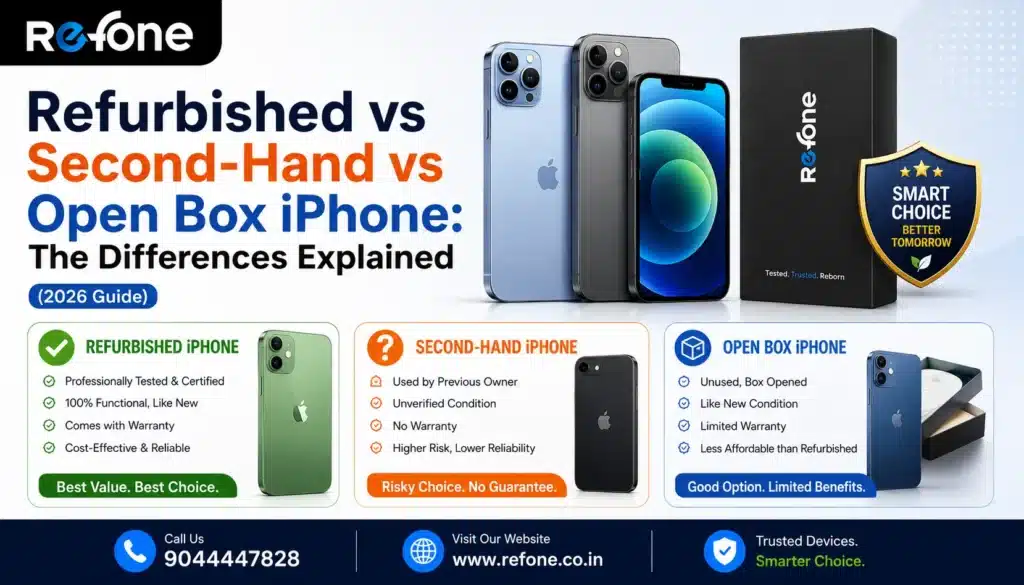
This guide clears up the confusion once and for all. By the end, you’ll know exactly what each term means, which one is safest for your money, and how to spot a genuine deal versus a trap. No jargon. No sales pitch. Just a clear, honest comparison — the kind we’d want if we were buying an iPhone ourselves.
Let’s get into it.
Why This Confusion Costs Indian Buyers Real Money
Here’s the problem. In India, “second-hand,” “refurbished,” and “open box” are often used as if they mean the same thing. They don’t.
A seller on a local classifieds app might call a three-year-old, water-damaged iPhone “refurbished” just because they wiped the screen and reset it. Meanwhile, a certified refurbisher might sell you a professionally tested, battery-replaced iPhone that performs like new — for a similar price.
If you can’t tell the difference, you’re gambling with your money. And an iPhone isn’t a small purchase. Getting this wrong means:
- Paying “refurbished” prices for a genuinely used, untested phone
- Losing warranty protection you thought you had
- Ending up with a device that has a hidden IMEI or battery problem
- No easy way to return or exchange it
The good news? Once you understand these three categories, this decision becomes simple. Let’s break each one down.
What Is a Refurbished iPhone?
A refurbished iPhone is a previously owned or returned device that has gone through a structured process before it’s resold. This isn’t just “cleaned and repackaged.” A proper refurbishment includes:
- Full diagnostic testing (camera, speakers, buttons, Face ID, charging port, and more)
- Battery health check, and replacement if it falls below a healthy threshold
- Replacing damaged parts with original or high-quality components
- Data wipe and factory reset for a clean start
- Cosmetic grading based on visible wear (like Grade A, B, or C)
- IMEI and activation lock verification, to confirm the device isn’t blacklisted or reported lost/stolen
Think of it like a used car that’s gone through a certified inspection center, versus one bought directly from a stranger’s driveway. Same basic product. Very different level of trust.
Refurbished Phone Meaning, In Simple Words
If someone asks, “what is a refurbished iPhone” in one line: it’s a pre-owned iPhone that has been tested, repaired where needed, and quality-checked by a professional refurbisher before being resold — usually with some warranty attached.
That warranty part matters a lot. It’s the single biggest difference between a genuine refurbished phone and a random used one.
What Is a Second-Hand iPhone?
A second-hand iPhone is simply a phone that’s changed hands — from one owner directly to another. This is the classic “used phone” you’d buy from:
- A friend, relative, or colleague
- A local seller on OLX, Facebook Marketplace, or similar platforms
- Someone upgrading and selling their old device privately
Here’s the key point: a second-hand iPhone comes with no guaranteed testing process. What you see is what you get. There’s no standard grading, no professional battery check, and usually no warranty at all.
Second-Hand iPhone Meaning
In one line: a second-hand iPhone is a used device sold “as-is,” directly between individuals, without formal inspection, certification, or warranty coverage.
That doesn’t automatically make it bad. Some second-hand sellers are honest and take great care of their phones. But you’re relying entirely on trust, and trust isn’t something you can verify from a WhatsApp chat and a few photos.
What Is an Open Box iPhone?
An open box iPhone is a slightly different animal altogether. It’s essentially a brand-new phone whose box was opened — but the phone itself was never really used, or was used for a very short time before being returned.
Common open box scenarios:
- A customer bought it, opened the box, changed their mind, and returned it within the return window
- A retail display unit that was opened for demo purposes but not sold to a customer
- An online order that got cancelled after the seal was broken during quality checks
Open Box iPhone Meaning
In one line: an open box iPhone is a nearly-new device with a broken factory seal, typically returned unused or barely used, and resold — usually at a small discount from full retail price.
So is an open box iPhone practically new? In most legitimate cases, yes. It’s the closest thing to brand-new without paying full brand-new pricing. But — and this is important — always confirm the return reason and get it checked, because a small number of open box units are returned due to a genuine defect.
Refurbished vs Second-Hand vs Open Box iPhone: Quick Comparison Table
Here’s the side-by-side view you’ve been looking for.
| Factor | Refurbished iPhone | Second-Hand iPhone | Open Box iPhone |
| Condition | Tested, repaired, graded | Unknown, as-is | Near-new, barely used |
| Testing process | Multi-point diagnostic check | None (self-reported by seller) | Minimal, only if returned for a defect |
| Battery health | Usually verified or replaced | Unknown, often degraded | Usually near 100% |
| Warranty | Often 12 months from seller | Rarely, if ever | Sometimes remaining original Apple warranty |
| Price vs new | 30–50% cheaper | 35–55% cheaper | 5–15% cheaper |
| IMEI/activation lock check | Verified before sale | Buyer must check themselves | Usually clean, but verify |
| Return policy | Common (7–15 days typical) | Rare or negotiable only | Sometimes, depends on seller |
| Risk level | Low, when bought from certified sellers | High | Low to moderate |
| Best for | Value + peace of mind | Very tight budgets, trusted personal seller | Buyers who want “almost new” for less |
This table alone answers most buyer-intent questions people search for — but let’s go a level deeper, because the real decision depends on your priorities.
Refurbished vs Second-Hand iPhone: Which One Actually Wins?
This is the most searched comparison, and for good reason. Both are “used” in some sense, but they’re worlds apart in safety.
Refurbished wins on:
- Verified battery health, so you’re not stuck with a phone that dies by 2 PM
- A proper warranty, so a fault after purchase doesn’t mean losing your money
- Professional testing across cameras, buttons, sensors, and connectivity
- Confirmed IMEI status, so you’re not buying a blacklisted or stolen device
Second-hand wins on:
- Sometimes a slightly lower upfront price
- Direct negotiation, which can work in your favor if you know the seller
The honest verdict: unless you personally know and trust the seller, a certified refurbished iPhone is almost always the smarter buy. You’re not just paying for the phone — you’re paying for verification, testing, and protection. That’s not a luxury. That’s risk management.
Refurbished vs Open Box iPhone: Which Is Better?
This is a closer contest, because open box phones are genuinely close to new.
Choose open box iPhone if:
- You want the newest model at a small discount
- You’re comfortable paying more for “barely touched” condition
- Stock is available for the exact model and color you want
Choose refurbished iPhone if:
- You want the biggest possible savings
- You’re okay with a slightly older model or light cosmetic wear
- You want a device that’s already been through rigorous multi-point testing, not just a quick return-desk check
Is open box iPhone better than refurbished? It depends on what you value more — a bigger discount (refurbished) or being closer to “box-fresh” (open box). Neither is objectively wrong. It’s a budget-versus-freshness trade-off.
Second-Hand vs Open Box iPhone: The Real Difference
People often confuse these two the most, so let’s simplify it in one line each:
- Second-hand = someone actually used this phone for weeks, months, or years before selling it.
- Open box = almost nobody used this phone. The seal was broken, but the usage was minimal or zero.
If cosmetic and battery condition matter to you, open box beats second-hand almost every time — for a bit more money.
Refurbished vs Pre-Owned vs Renewed: Are These the Same?
You’ve probably seen these terms too. Quick clarifications:
- Pre-owned is often just a softer marketing term for “used” — it can mean second-hand or refurbished, depending on the seller. Always check what testing was actually done.
- Renewed (a term popularized by large marketplaces) usually refers to professionally refurbished devices, similar in spirit to “refurbished,” but standards can vary by platform.
The takeaway: don’t trust the label alone. Trust the process behind the label — testing, grading, battery health, and warranty.
Refurbished iPhone Buying Guide: What to Check Before You Pay
Whether you buy refurbished, open box, or second-hand, this checklist protects you every time.
1. Battery Health
Anything below 85% battery health means noticeably shorter daily use. Ask for the battery health percentage before buying, in writing.
2. IMEI and Activation Lock Verification
Every genuine seller should let you check the IMEI status. This confirms the phone isn’t reported lost, stolen, or blacklisted, and that Find My iPhone is properly turned off by the previous owner.
3. Cosmetic Grading
Understand what “Grade A,” “Grade B,” or “Grade C” actually means with that specific seller. There’s no universal standard, so ask for photos or a video of the exact grading criteria.
4. Warranty and Return Window
A refurbished phone with zero warranty is really just an unverified second-hand phone with better marketing. Look for at least a 6-month warranty and a short return window (7–15 days) to test the device risk-free.
5. Original Parts Confirmation
Ask if the screen, battery, and camera module are original Apple parts or third-party replacements. This affects long-term performance and resale value.
6. Face ID and True Tone Functionality
These features can break if non-original parts were used during repair. Always test them in person or ask for confirmation before purchase.
7. Full Diagnostic Report
A trustworthy refurbisher will show you a diagnostic report covering the screen, speakers, mic, cameras, Wi-Fi, Bluetooth, charging, and sensors — not just “it works fine.”
Real Buyer Scenarios: Which Option Fits You?
Riya, a college student in Pune, needed an iPhone for photography assignments but had a tight budget. A certified refurbished iPhone with verified battery health gave her 80% of the new-phone experience at nearly half the price — with a warranty as backup.
Arjun, a working professional, wanted the latest iPhone model but wasn’t ready to pay full retail. He found an open box unit — barely opened, original packaging, small discount — and got what felt like a brand-new phone.
Meena, buying from a family friend, chose second-hand because she trusted the seller personally and could physically test the phone for a week before paying. That trust is what made second-hand work safely for her — something a stranger online can’t offer.
Your situation probably looks like one of these three. That’s the fastest way to decide.
Common Myths About Refurbished iPhones (Busted)
Myth: Refurbished phones are just used phones with a new sticker. Truth: Genuine refurbished phones go through diagnostic testing, part replacement, and grading — a used phone typically doesn’t.
Myth: Refurbished iPhones don’t get software updates. Truth: A refurbished iPhone runs the same iOS as any other iPhone of that model. Updates work identically.
Myth: You can’t get warranty on a refurbished device. Truth: Reputable refurbishers offer their own warranty, separate from Apple’s original warranty, typically 6 to 12 months.
Myth: All refurbished phones have replaced, low-quality batteries. Truth: Trusted sellers use quality-tested or original-spec batteries and disclose battery health clearly before sale.
How Certified Refurbishers Test a Phone (Behind the Scenes)
Ever wondered what actually happens before a refurbished iPhone reaches your doorstep? A professional refurbishment process typically includes:
- Intake inspection – checking the device’s origin, IMEI, and initial condition
- Data wipe – securely erasing all previous owner data
- Full diagnostics – testing 30-40+ functional points, from Face ID to haptic feedback
- Battery testing – measuring cycle count and health percentage
- Part replacement – swapping any faulty component with quality-verified parts
- Deep cleaning and cosmetic grading – sorting into condition categories
- Final quality check – a second round of testing before packaging
- Warranty assignment – attaching coverage before it’s listed for sale
This is exactly the kind of transparent, verified process worth asking about before you buy from any refurbisher.
Refurbished iPhone Price vs New iPhone Price: Is the Saving Worth It?
Generally, refurbished iPhones cost 30-50% less than a brand-new equivalent model, depending on the generation and condition grade. Open box units save you a smaller amount, typically 5-15%, but you get near-new condition. Second-hand phones can be the cheapest option upfront, but factor in the hidden cost of no warranty and unknown battery health — a repair bill later can wipe out your “savings” quickly.
The real question isn’t “which is cheapest today.” It’s “which gives me the lowest total cost of ownership over the next 12-18 months.” That’s where verified refurbished and open box options usually win.
FAQs: Refurbished vs Second-Hand vs Open Box iPhone
Q1. Which is better, refurbished or second-hand iPhone?
A certified refurbished iPhone is generally safer than a second-hand one because it comes with testing, battery verification, and warranty — protections a private second-hand sale rarely offers.
Q2. Is an open box iPhone worth buying?
Yes, in most cases. An open box iPhone is close to brand-new condition since it was barely used, and it usually comes at a modest discount from full retail price.
Q3. Can I trust a refurbished iPhone?
Yes, if you buy from a certified refurbisher that provides diagnostic reports, battery health details, IMEI verification, and a clear warranty. Avoid unverified sellers with no testing proof.
Q4. What is the safest iPhone to buy on a budget?
A certified refurbished iPhone from a trusted seller is typically the safest budget option, because it combines lower price with tested quality and warranty backup.
Q5. Which iPhone option gives better value for money?
Refurbished iPhones usually offer the best value, balancing meaningful savings with verified quality and warranty protection, unlike unverified second-hand devices.
Q6. Why are refurbished iPhones cheaper than new ones?
Because they are pre-owned or previously returned devices. Even after professional testing and repair, resellers price them below new-phone rates since they aren’t “sealed, first-owner” units.
Q7. How can I verify a refurbished iPhone before buying?
Check the IMEI status, ask for the battery health percentage, request a diagnostic report, confirm original parts were used, and check the warranty and return policy in writing.
Q8. Should students buy refurbished iPhones?
Yes, refurbished iPhones are a smart choice for students who want Apple’s ecosystem and camera quality without paying full new-phone prices, especially when warranty is included.
Q9. Is a refurbished iPhone good for daily use, including gaming and photography?
Yes. A well-refurbished iPhone performs the same as a new one of that model for daily tasks, photography, and most gaming, since the internal chip and camera hardware aren’t changed.
Q10. What is the difference between refurbished and pre-owned phones?
“Pre-owned” is often a general marketing term that could mean either second-hand or refurbished. Always confirm whether the phone was professionally tested and graded, or simply resold as-is.
Q11. Refurbished aur second hand iPhone mein kya fark hai?
Refurbished iPhone testing, battery check aur warranty ke saath aata hai, jabki second hand iPhone bina kisi verification ke seedha ek user se doosre user tak jaata hai.
Q12. Open box iPhone kya hota hai?
Open box iPhone matlab wo phone jiska box khola gaya tha lekin phone bilkul naye jaisa ya bahut kam use hua hota hai — usually return ya display unit ki wajah se.
Q13. Kya refurbished iPhone lena safe hai?
Haan, agar aap certified refurbisher se lete hain jo battery health, IMEI verification, aur warranty deta hai, to refurbished iPhone lena bilkul safe hota hai.
Q14. Second hand iPhone lena chahiye ya refurbished?
Agar aap seller ko personally jaante hain to second hand theek hai, lekin unknown seller se lena hai to refurbished iPhone zyada safe option hai kyunki usme testing aur warranty milti hai.
Q15. Open box iPhone mein warranty milti hai kya?
Kai baar open box iPhone ke saath Apple ki original warranty ka bacha hua time milta hai, lekin ye seller aur return reason par depend karta hai — hamesha confirm kar lein.
Q16. Refurbished iPhone ka battery health kitna hona chahiye?
Kam se kam 85% ya usse zyada battery health wala refurbished iPhone lena chahiye, taaki daily use mein battery jaldi khatam na ho.
Q17. Kaise pata karein ki refurbished iPhone genuine hai ya nahi?
Diagnostic report maangiye, IMEI check kariye, battery health confirm kariye, aur ye dekhiye ki seller warranty aur return policy clearly likhkar de raha hai ya nahi.
Conclusion: Making the Right Choice for Your Money
Here’s the honest summary.
- Want the biggest savings with real protection? Go refurbished — but only from a certified seller with testing and warranty.
- Want near-new condition and are okay with a smaller discount? Go open box.
- Have a personally trusted seller and want the lowest possible upfront price, and can accept zero warranty? Second-hand can work.
Most buyers, especially in India where after-sales support is limited, find that certified refurbished iPhones offer the best balance of price, safety, and peace of mind. You get Apple’s camera quality, performance, and ecosystem — without new-phone pricing, and without second-hand-level risk.
Why Buy Your Refurbished iPhone From Refone
At Refone, every refurbished iPhone goes through a multi-point diagnostic check, verified battery health testing, original parts inspection, and full IMEI and activation lock verification before it’s listed for sale. Every device comes with clear cosmetic grading, so you know exactly what condition you’re getting, and a warranty that actually backs you up if something goes wrong.
We built Refone because we believe you shouldn’t have to choose between an affordable iPhone and a trustworthy one. You deserve both.
Ready to find your next iPhone? Browse Refone’s certified refurbished iPhone collection today, and get the camera quality, performance, and reliability of an iPhone — at a price that actually makes sense.
This guide is based on independent research into refurbishment industry standards and common buyer concerns. Always verify battery health, IMEI status, and warranty terms directly with your seller before purchasing.
Leave a Reply
Your email address will not be published. Required fields are marked *