 Download App
 Track Order
 Help Center

How Refone Tests Every iPhone Before Sale: 52+ Quality Checks Explained
You found a refurbished iPhone at half the price of a new one. Feels like a win, right?
Then the doubt creeps in.
Will the battery die in 6 months? Is the camera scratched under that “mint condition” listing? What if the IMEI is blacklisted? What if it’s a stolen phone with an iCloud lock waiting to ruin your day?
Get Super Grade iPhones – 70% OFF Price
If these questions have stopped you from clicking “Buy Now,” you are not being paranoid. You are being smart. Most sellers in India’s used-phone market do a 5-minute glance — check if it switches on, check if the screen looks fine, done. That’s not a refurbished iPhone quality check. That’s a gamble with your money.
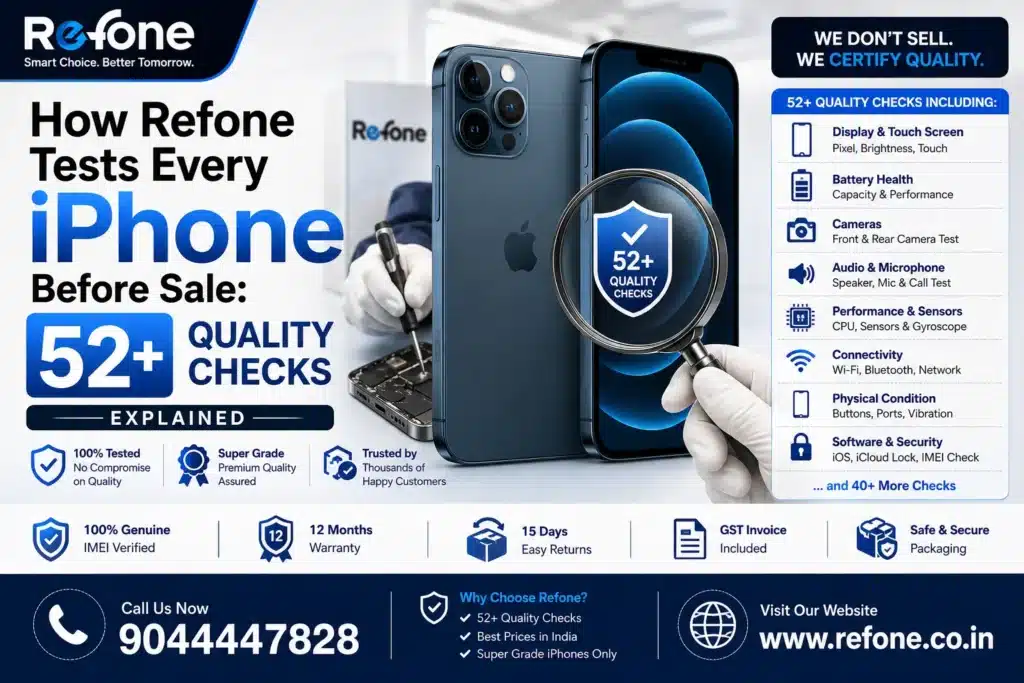
This article breaks down exactly how Refone tests every single iPhone before it reaches you — 52+ documented checks covering hardware, software, battery, camera, display, and security. No vague promises. No “trusted by lakhs of customers” fluff. Just the real iPhone testing before sale process, explained step by step, so you know precisely what you’re paying for.
By the end, you’ll know exactly what to look for — whether you buy from Refone or anywhere else.
What Does a Refurbished iPhone Quality Check Include?
A refurbished iPhone quality check is a structured, multi-point inspection that tests every hardware component (screen, camera, battery, speakers, buttons), every software function (iOS performance, Face ID, connectivity), and every security detail (IMEI, iCloud lock, ownership) before the device is approved for resale. At Refone, this covers 52+ individual checks split across five categories, and a phone is only listed for sale once it clears all of them.
That’s the short answer. Now let’s go deep — because “trust us” isn’t enough when you’re spending real money on a used iPhone.
Buy Certified Refurbished iPhone
Super Quality iPhones at Smarter Prices
Why Most Used iPhones Fail the Trust Test
Here’s an uncomfortable truth about India’s second-hand phone market.
- A large share of listings on classifieds and reseller sites have no documented inspection at all.
- Sellers often hide battery degradation, screen swaps, or water damage behind a good-looking exterior.
- IMEI blacklisting, iCloud lock, and stolen-device issues are common complaints in online buyer forums.
- “Refurbished” is sometimes just marketing language for a wiped, unchecked used phone.
This is exactly why buyers search for terms like refurbished iPhone inspection process, iPhone condition check, and *how to verify refurbished iPhone quality before buying. People aren’t just shopping — they’re trying to protect themselves.
A professional refurbished iPhone testing process exists to solve this exact problem. It replaces guesswork with documented, repeatable **quality assurance process** steps — the same kind of discipline you’d expect from a certified electronics workshop, not a roadside phone stall.
Also Read – Refone New Store in Howrah AC Market: Your Trusted Refurbished iPhones Destination in 2026
How Refone 52+ Point Inspection Works
Every device that enters Refone facility goes through end-to-end iPhone inspection — from the moment it arrives to the moment it’s boxed for dispatch. Think of it as five checkpoints, and a phone has to clear all five before it earns the “Refone Verified” tag.
Here’s the entity map our technicians actually follow:
Refone → refurbished iPhone → 52+ checks → hardware → software → battery → IMEI & security → camera & display → final quality approval
Let’s walk through each stage.
Stage 1: Authenticity & Security Verification (Cluster D)
Before any technician even opens the device settings, the phone has to prove it’s genuinely sellable. This is the step most casual sellers skip completely — and it’s the one that protects you the most.
- iPhone IMEI verification against Apple’s official database
- IMEI check before buying cross-referenced with blacklist and insurance-claim records
- iCloud lock check to confirm the device isn’t tied to a previous owner’s Apple ID
- Activation Lock verification to rule out Find My iPhone restrictions
- Apple device authenticity check to confirm original, non-counterfeit parts
- Stolen iPhone check against national and international databases
- Carrier lock verification so the phone works with any Indian SIM
- Serial number verification matched against Apple’s manufacturing records
- Find My iPhone status confirmed as fully removed
- Ownership verification documentation completed
If a phone fails even one of these, it does not move forward. Full stop. This is the difference between a **verified refurbished iPhone** and an ordinary second-hand listing.
Stage 2: Hardware Testing (Cluster B)
Once security clears, technicians move to physical and mechanical testing — the iPhones hardware inspection stage.
- Display testing iPhone for cracks, discolouration, and panel response
- Touchscreen testing across every zone of the screen, corner to corner
- Speaker test iPhone for both earpiece and loudspeaker clarity
- Microphone test iPhone across calls, voice memos, and video recording
- Charging port inspection for pin damage, dust, and connection stability
- Button functionality test — power, volume, mute switch
- Vibration motor test for haptic feedback strength
- Camera hardware testing — lens, sensor, and housing integrity
- Face ID testing for accurate biometric recognition
- Wireless charging test on Qi-compatible pads
- MagSafe functionality test for magnetic alignment and charging speed
Stage 3: Software & System Verification (Cluster C)
Hardware can look perfect and still hide software problems. This is why iOS functionality test procedures run separately.
- iPhone software diagnostics** using Apple’s official diagnostic tools
- System performance testing under real usage load
- iOS diagnostic check for crashes, freezing, or lag
- Apple device functionality test across all built-in apps
- Operating system verification to confirm genuine, updated iOS
- Software health check for corrupted files or unauthorized modifications
- Device diagnostic testing covering sensors and internal chips
- iPhone performance diagnostics benchmarking speed against Apple specs
- System stability testing through extended stress cycles
Stage 4: Battery Testing (Cluster E)
Battery complaints are the #1 reason people hesitate before buying a used iPhone. That’s why iPhone battery health check gets its own dedicated stage, not just a glance.
- Battery cycle count verified through diagnostic software
- iPhone battery diagnostics measuring real-time performance
- Battery performance test under active charge and discharge cycles
- Battery health verification confirmed against Apple’s health percentage standard
- Charging performance test for speed and consistency
- Battery capacity check compared to original manufacturer rating
- iPhone power management tested across background and active use
- Battery condition assessment for swelling, overheating, or degradation
- Battery replacement verification — if a battery was replaced, only Apple-grade cells are approved
Refone standard: A device only passes battery testing if it holds a strong, documented battery health percentage — not a “should be fine” guess.
Also Read – Refurbished iPhone Hidden Problems Buyers Ignore (2026)
Stage 5: Camera & Display Testing (Cluster F)
Because camera quality matters so much to buyers — especially anyone searching for the best refurbished iPhone for camera lovers — this stage is treated as its own dedicated checkpoint, not a quick add-on.
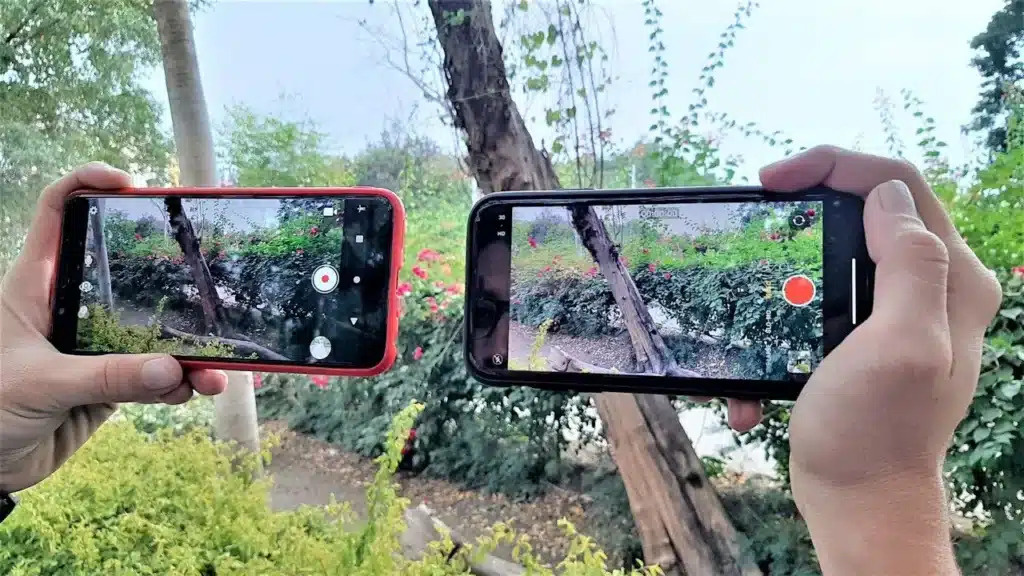
- **iPhone camera test** across all lenses (wide, ultra-wide, telephoto where applicable)
- **Front camera inspection** for selfie clarity and focus
- **Rear camera testing** in different lighting conditions
- **Camera focus test** for autofocus speed and accuracy
- **Portrait mode test** for depth-sensing accuracy
- **Face ID camera testing** for TrueDepth sensor reliability
- **OLED display test** for color accuracy and panel health
- **Screen touch test** for full responsiveness
- **Dead pixel test** run at multiple brightness levels
- **Display brightness test** compared to Apple’s original spec
- **True Tone verification** for accurate color temperature adjustment
Bonus connectivity round: Wi-Fi testing, Bluetooth testing, cellular connectivity, GPS functionality, and NFC functionality are all confirmed working before final approval — because a phone that fails to connect properly isn’t ready to sell, no matter how good it looks.
Comparison: Refone Tested iPhone vs Ordinary Second-Hand iPhone
| Factor | Refone Verified iPhones | Ordinary Used iPhone (Untested) |
| IMEI & ownership verification | Documented, checked against Apple database | Rarely disclosed |
| Battery health | Measured and disclosed before sale | Usually unknown |
| Camera & display testing | 20+ dedicated checks | Visual glance only |
| iCloud / Activation Lock | Verified fully removed | Risk of lock after purchase |
| Software diagnostics | Full iOS system test | Not performed |
| Warranty / after-sale support | Typically included | Rarely offered |
| Documented quality checks | 52+ point process | None |
This table alone answers a question thousands of Indian buyers type into Google every month: *what is the difference between a tested refurbished iPhone and an ordinary used iPhone?* The gap isn’t cosmetic — it’s about risk. One route gives you documentation. The other gives you hope.
Also Read – How to Check iPhone IMEI Number — 5 Easy Ways (2026)
What Happens If a Device Fails a Check?
Transparency matters here, so let’s be direct.
- If a phone fails a hardware check, the faulty component is either repaired with genuine-grade parts or the device is rejected entirely — never sold as-is.
- If battery health falls below the Refone threshold, the battery is replaced before the phone can proceed.
- If there’s **any IMEI, iCloud, or ownership red flag**, the device is pulled from the sale pipeline immediately. No exceptions.
- Devices with **irreparable structural or motherboard damage** are not refurbished for resale — they’re recycled responsibly instead.
This “fail = fix or reject” rule is what separates a **documented quality control process** from a shop that just wipes a phone and relists it.
How the Final Device Grade Is Determined
Once a phone clears all 52+ checks, it’s assigned a condition grade based on:
1. Cosmetic condition — screen, back glass, and frame wear
2. Functional performance — how it scored across hardware and software diagnostics
3. Battery health percentage — verified, not estimated
4. Camera and display accuracy — tested under real lighting and usage conditions
This grading is what lets you compare listings honestly, instead of relying on photos and a seller’s word.
What Our Technicians Actually Inspect: A Buyer’s Quick Checklist
If you’re evaluating any refurbished iPhone — from Refone or elsewhere — ask the seller these questions before you pay:
- Has the IMEI been verified against Apple’s database?
- Is the iCloud lock and Activation Lock confirmed removed?
- What is the documented battery health percentage?
- Has the camera been tested in different lighting conditions?
- Is there a written report of the inspection, or just a verbal assurance?
- Does the phone come with any warranty or return window?
If a seller can’t answer these clearly, that’s your signal to walk away.
Real-World Impact: Why This Process Matters
Consider two buyers in Varanasi shopping for the same iPhone model at similar prices.
Buyer A picks it up from a local reseller with no paperwork. Three months later, the battery drains by afternoon, and there’s no one to call.
Buyer B buys the same model as a certified refurbished iPhone with documented battery health, verified IMEI, and a warranty. Six months later, it performs like new.
Same phone model. Same price bracket. Completely different ownership experience — because of what happened before the sale, not after. That’s the entire point of a pre-sale iPhone quality assurance process.
Why “52+ Checks” Isn’t Just a Number
A lot of refurbished phone websites throw around numbers — “40-point check,” “60-point check,” “100-point check” — without ever listing what those points actually are. That’s a red flag disguised as a trust signal.
At Refone, every one of the 52+ checks maps to a specific, testable outcome. Not “check the phone” — but “run Face ID recognition test five times across three lighting conditions and record the pass/fail result.” Not “check the battery” — but “measure battery cycle count and maximum capacity using Apple’s diagnostic protocol, then compare against the manufacturer’s health threshold.”
This is the difference between documented quality checks and marketing language. If a company can’t tell you what their inspection points are, the number itself means nothing.
When you’re comparing sellers, ask this one question: “Can you show me the actual checklist?” A seller with a genuine quality control process will have no problem answering. A seller without one will change the subject.
Also Read – The Checklist Before Buying Refurbished Phones In India (2026 Guide)
The Real Cost of Skipping Inspection
Let’s talk numbers, because emotional trust only goes so far.
A typical iPhone battery replacement in India can cost anywhere from ₹3,000 to ₹8,000 depending on the model. A cracked back glass repair can run similarly high. A camera module replacement, especially on newer Pro models, can cost even more. If you buy an untested “refurbished” iPhone and discover a hidden fault within the first month, you’re not just out the purchase price — you’re looking at unplanned repair costs on top of it.
Now compare that to buying from a seller who has already:
- Replaced any weak battery with an Apple-grade cell before listing the phone
- Repaired or ruled out any camera and display issues during pre-sale device inspection
- Verified there’s no IMEI or ownership problem waiting to surface later
The refurbished iPhone quality control process isn’t an added cost buried in the price — it’s what prevents you from paying twice for the same phone.
What Makes a Refurbished iPhone Seller Trustworthy?
If you’re researching *what should I look for when choosing a reliable refurbished iPhone seller in India*, here’s a practical framework you can apply to any seller, not just Refone:
1. They publish their testing process. Not a single line saying “quality checked,” but an actual breakdown of what’s tested.
2. They disclose battery health as a number, not a vague “good condition” label.
3. They verify and share IMEI status before you commit to buying.
4. They offer a warranty or return window — confidence in your own testing process shows up as a real guarantee, not just words.
5. They grade devices by condition (like “Excellent,” “Good,” “Fair”) based on actual inspection results, not guesswork.
6. They’re reachable after the sale. A seller who disappears once payment clears was never confident in their product to begin with.
Run any refurbished iPhone listing through this checklist before you buy — whether it’s from Refone, a marketplace, or a local shop. It takes two minutes and can save you months of frustration.
Camera Testing: Why It Deserves Extra Attention
If photography matters to you — and for a lot of iPhone buyers, it’s the single biggest reason they choose Apple over other brands — camera testing deserves a closer look.
A phone can pass a basic “does it turn on” check and still have:
- A slightly misaligned lens affecting autofocus speed
- A scratched lens cover that shows up only in bright, direct light
- A Face ID camera that struggles in low light after a previous repair
- Portrait mode depth mapping that’s slightly inaccurate after a screen or camera module swap
This is exactly why camera hardware testing at Refone isn’t a single “does the camera app open” check — it’s a set of tests across lighting conditions, focus accuracy, and portrait depth sensing. For anyone specifically hunting for the best refurbished iPhone for camera lovers, this stage of testing is arguably the most important one in the entire process.
Frequently Asked Questions
How does Refone test refurbished iPhones?
Refone runs a 52+ point inspection covering IMEI and ownership verification, hardware testing (screen, camera, speakers, buttons), software diagnostics, battery health checks, and camera/display accuracy tests — before any device is approved for sale.
What quality checks are performed on a refurbished iPhone?
Checks include display and touchscreen testing, camera and Face ID testing, battery cycle count and health verification, IMEI and iCloud lock verification, speaker and microphone testing, and full iOS software diagnostics.
How can I tell if a refurbished iPhone is good quality?
Look for documented battery health percentage, confirmed IMEI verification, a written inspection report, working Face ID and cameras, and a warranty or return policy. Absence of any of these is a red flag.
What should be checked before buying a refurbished iPhone?
At minimum: IMEI status, iCloud/Activation Lock removal, battery health, camera and display condition, and connectivity (Wi-Fi, Bluetooth, cellular, GPS).
How is a refurbished iPhone tested before being sold?
It goes through sequential stages — security and authenticity verification first, then hardware testing, software diagnostics, battery testing, and finally camera and display checks — before receiving a final quality grade.
How do refurbished phone companies check battery health?
Using Apple’s official diagnostic tools to measure battery cycle count, maximum capacity percentage, charging performance, and thermal behavior under load.
How do you verify an iPhone’s IMEI before purchase?
The IMEI is checked against Apple’s official records and blacklist databases to confirm the device isn’t stolen, blacklisted, or tied to unresolved insurance claims.
How can I check whether an iPhone has been repaired?
A professional inspection checks for genuine versus third-party parts, checks Apple’s parts and service history where accessible, and inspects screws, adhesive seals, and internal component matching.
How do you test Face ID on a refurbished iPhone?
Technicians run repeated biometric recognition tests using the TrueDepth camera system to confirm accurate, consistent unlocking across different lighting conditions.
What makes a refurbished iPhone high quality?
A combination of strong battery health, fully functional cameras and display, verified IMEI and ownership, complete software diagnostics passed, and transparent documentation of the entire testing process.
What checks should a refurbished iPhone pass before sale?
At a minimum, it should pass IMEI and ownership verification, iCloud/Activation Lock removal, full hardware testing (screen, camera, speakers, buttons, ports), complete iOS diagnostics, and a documented battery health check.
Is a professionally tested refurbished iPhone safe to buy?
Yes. A refurbished iPhone that has passed a documented multi-point inspection — covering security, hardware, software, battery, and camera testing — carries significantly lower risk than an untested used phone, and often comes with a warranty for added protection.
Why does multi-point inspection matter when buying a refurbished iPhone?
Because a phone can look flawless on the outside while hiding battery degradation, software issues, or a locked iCloud account. Multi-point inspection catches problems that a visual check alone would miss, protecting you from costly surprises after purchase.
Which quality checks matter most when buying a pre-owned iPhone?
Battery health, IMEI verification, iCloud/Activation Lock status, and camera/display condition are the four checks that most directly affect your day-to-day experience and resale value, so prioritize confirming these first.
Refone iPhone ka quality check kaise karta hai?
Refone har iPhone ko 52+ point inspection se guzarta hai — ismein IMEI verification, battery health check, camera aur display testing, aur software diagnostics shaamil hain. Jab tak phone sab checks pass nahi karta, use sale ke liye approve nahi kiya jaata.
Refurbished iPhone lene se pehle kya check karna chahiye?
Battery health percentage, IMEI status, iCloud lock removal, camera aur screen ki condition, aur warranty zaroor check karein. Agar seller yeh details nahi de sakta, toh saavdhaan rahein.
Kaise pata chalega ki refurbished iPhone genuine hai ya nahi?
IMEI ko Apple ke database se verify karke aur serial number match karke genuine device confirm kiya ja sakta hai. Refone yeh verification har phone par karta hai bikri se pehle.
Refurbished iPhone ki battery health kaise check hoti hai?
Apple ke official diagnostic tools se battery cycle count aur maximum capacity measure ki jaati hai, jisse pata chalta hai ki battery kitni healthy hai.
Kya refurbished iPhone lena safe hai?
Haan, agar phone ek documented, multi-point inspection process se guzra ho — jaise Refone ka 52+ point check — toh yeh naye phone jaisa hi reliable ho sakta hai, kaafi kam price mein.
Refone Trust Statement
We don’t ask you to trust us because we say so. We ask you to trust the process — 52+ documented checks, applied to every single device, every single time, with no shortcuts for speed or margin.
If a phone doesn’t pass, it doesn’t get sold. That’s the standard we hold ourselves to, and it’s the standard you deserve as a buyer.
Ready to Buy With Confidence?
Stop gambling on unverified listings. Every Refone refurbished iPhone comes with a documented 52+ point quality check — covering hardware, software, battery, camera, display, IMEI, and security — before it ever reaches you.
**Browse Refone’s verified refurbished iPhone collection today** and experience what a professionally tested device actually feels like.
Leave a Reply
Your email address will not be published. Required fields are marked *